Masako and Spam Musubi


Masako savoring her Spam Musubi Kailua. Her daughter Izumi looks on.

It was a small yet precious family reunion. My 78 year old cousin Masako Kanemoto, who flew in from Hiroshima, took a bite out of a “Spam™ musubi” while we were taking a snack break in Kailua, Hawai’i. It’s a slice of Spam sandwiched in between some rice and wrapped in seaweed. “How mundane,” I thought.

Masako then beamed. “We had very little food for so many years. After the war, your father brought us food and clothing when he was in the US Army…” My dad was part of the US 8th Army’s Military Intelligence Service.

She continued, “He brought us much as he could carry. I was so hungry and I will always remember that first bite. I couldn’t believe how something could be so delicious.” She was referring to something my father had brought along with him 65 years ago – Spam.

Emotions tore through me and my eyes welled rapidly. I felt so selfish and ignorant for taking the Spam for granted. I fumbled but snapped the photo of Masako enjoying the Spam musubi.

__________________________

My grandfather Hisakichi Kanemoto immigrated from Hiroshima to Seattle in the late 1890′s. My grandmother Kono Kanemoto was a true picture bride for my grandfather. Grandmother gave birth to a total of seven children of which my father was the fifth; all but one was born in Seattle – they were US citizens.

My grandparents struggled to survive; the family lived in the Fujii Hotel in downtown Seattle. They worked a basement barber shop in the hotel with Grandfather cutting the hair and Grandmother expertly working the straight razor. A cousin said Grandmother made the customers feel appreciated and made them feel at ease with her people skills. It certainly wasn’t Grandfather – if there were a Japanese Marine, he could have been their poster boy. “By the book”, as they say.

As was customary during that time, many Japanese-American children (“Nisei”) were rotated back to Hiroshima by ship to learn the Japanese language and customs when they were about eight years old. It was no easy cruise has they were crammed into the cargo hold for the lowest fares. They spent about ten years in Hiroshima then returned by themselves when they turned 18.  Dad was no exception.

By around 1930, the grandparents and five of the siblings were in Hiroshima; the oldest (Uncle Yutaka) was forced to live in America alone at a young age. I understand he was sad and frightened about that. Their second son, Hisao, passed away in Seattle from encephalitis when he was only about two.

Now fluent in Japanese, dad returned to Seattle on his own in 1937 at 18 years of age, preceded by an older sister Shizue in 1934. Dad was apparently very bright as he graduated from Hiroshima’s Nichuu High School – it was for the higher achievers. He excelled in mathematics as well as in track and swimming. He helped dig the school’s pool. No union labor back then.

Dad is standing, third from left in this rare family portrait taken in front of his family’s new Hiroshima home, circa 1929.

_______________________

After dad returned to Seattle, Grandmother made the decision to remain in Hiroshima. It was a fateful decision.

In the 1930′s, Japan had already began their invasions of China, Manchuria and Burma; they were on their quest to secure raw materials for their industries and ultimately for their military. National pride was at its peak; military conquests filled the news and the world was taking notice with great consternation. When Japan was condemned for their aggressions by the League of Nations, she withdrew and shocked the world.

The threat of war with America loomed. Anti-Japanese sentiment grew – Americans in Seattle routinely harassed or even attacked Japanese in public. Unfortunately, many of the “Japanese” they harassed were American citizens like my dad, uncles and aunts. Some young Nisei girls were also groped, molested or raped.  Folks knew where Hawai’i was at this time but Pearl Harbor was Timbuktu.

They all had the misfortune of looking Japanese, similar to how some Americans look upon Muslims today.

My Grandmother was not exempt from the harassment. She was called “Jap” many times. She was even egged. While she was a fighter, she decided the threats and discrimination were too much.

______________________________

Matsutake

My dad was close to his youngest brother, Suetaro. They farmed the mushroom property Grandfather owned in Hiroshima; the special mushroom delicacy called “matsutake” grew only during a brief season. Dad, Uncle Suetaro and perhaps three other boys strapped on woven baskets onto their backs and filled them with the precious matsutake. Grandmother would sell them as quickly and as best she could – they had no refrigeration. The earnings would make up the bulk of their income for the year.

While dad had returned to Seattle in 1937, Uncle Suetaro was anxiously awaiting his turn to go back to Seattle. He was to turn 18 in 1939. However, Dad’s youngest sister Mieko died earlier in 1939 of a kidney infection; she was about 15 years old. By that time, Grandmother knew Grandfather was suffering from stomach cancer. His older sister (and the only one not born in the United States) Michie had married and had given birth to a daughter – Masako, my cousin. They lived in another village called “Tomo” some distance away.

Having decided to remain in Japan due to the harassment and threats she experienced, Grandmother then made the fateful decision to not allow Uncle Suetaro to return to Seattle. After all, there was no other Kanemoto left to inherit the house and land. Uncle Suetaro was dejected and very upset but obeyed Grandmother. He was a loyal son.

Grandfather died the next year. With Mieko also gone, only Grandmother and Uncle Suetaro remained in the house.

______________________________

Uncle Suetaro was drafted into the Japanese Imperial Army. His regiment was training in Fukuyama, Hiroshima. Aunt Michie with her nine year old daughter (and my cousin) Masako in tow went to visit Uncle Suetaro when they could. She remembers a couple of trips. It was not easy travel in war-torn Japan. For one trip, Aunt Michie managed to take sashimi – in this time of little food, it was a tremendous treat and gift.

On that trip, Masako remembers her mother stealthily sliding over to Uncle Suetaro the wrapped sashimi. He was being stared at by many of his fellow soldiers – they were not well fed either. She remembers Uncle slowly turning so that the others could not see and quickly devoured the treat.

Masako also knows Uncle was well respected by his fellow soldiers due to his knowledge of English in a wicked twist of fate as my father’s top secret US Army unit used their knowledge of Japanese to kill as many of the enemy and to save American lives.

_______________________________

Uncle Suetaro (sitting on the sofa arm) received his orders to ship out to Leyte Gulf in the Philippines; the family recalls it to be 1944. As tradition called, they had a farewell celebration. In such celebrations, the soldier who was facing certain death received a Japanese flag signed by relatives and friends to carry into battle.

Uncle Suetaro was to ship out the next day. Grandmother was like any other mother – she was anguished. More so, she knew that soldiers sent off to war rarely returned unless maimed. Her decision to not allow her youngest son to return to Seattle in 1939 now deeply stabbed at her heart…so much so that she suffered her first stroke the next day.

______________________________

Grandmother only had use of her right arm; Masako said she would pull herself around the now empty house with that one good arm. Aunt Michie – after working a grueling day at her husband’s farm – would likely have walked several miles to Grandmother’s house to tend to her needs which included feeding her as well as changing and washing her diapers.

This was war time; they used old clothing for diapers. Tide laundry soap? They didn’t have any soap to speak off. A washing machine? They didn’t have one let alone electricity. Aunt Michie washed them by hand with well water on a washboard. She then walked miles back to her farm only to get up a few hours later before dawn to work the farm.

______________________________

Transport Kashii Maru under attack at Ormoc Bay 1944

No one truly knows how Uncle Suetaro died.

Perhaps he was killed during one of the numerous Allied artillery barrages or bombings, or was cut down in a futile banzai charge. Perhaps he died in a cave from starvation or illness – or from committing suicide.

Perhaps he never made it ashore and met his death when he was on a troopship being strafed or sunk by airplanes from land-based US Marine Corsairs or carrier-launched US Navy F6F Hellcats or a US Army Air Force P-38 Lightning. The Allies ruled the skies and wrecked havoc on Japanese ships.

Tragically, he was American. While his oldest siblings were imprisoned in US concentration camps for “looking Japanese”, Uncle was thrust into desperate circumstances and was clothed in the uniform of the 14th Japanese Imperial Army, 41st Mixed Brigade… Eerily similar to his mother who was egged and called a Jap while in Seattle, his own countrymen were now trying to kill him with 75mm shells launched from miles away or .50 caliber machine gun rounds in a closer encounter. Not eggs this time.

It is more troubling knowing Ike was of German ancestry and MacArthur’s right hand man General Willoughby was of ROYAL German lineage and spoke fluent German but English with a pronounced accent. His birth name was Weidenbach; imagine if they were imprisoned in Tule Lake with my Dad for “looking German”.  No political comment being made; its just historical fact.

Uncle Suetaro’s 41st Mixed Brigade – likely including the other young men who watched him stealthily eat sashimi – was annihilated by the US Army on Leyte.  His body was never recovered. Ironically, when I used to watch the B&W news reels of the war on TV or see combat photos of dead Japanese soldiers, I would see them with purely American eyes. Now, I earnestly review them in hopes of seeing a glimpse of Uncle Suetaro…as my Aunt Shizue did for many, many years. She still does at 95 years of age near Downtown, LA.

__________________________

Eleven year old Masako was sitting in her classroom on August 6, 1945; her school was partially behind Mt. Suzugamine just west of Hiroshima’s center. Some windows were opened as it was in the middle of summer.

There was an indescribable, blinding white flash. There was no noise except for some of the girls screaming, Masako recalls. They all left their seats and ran towards the windows to see what had happened. Masako ended up standing behind a couple of girls at an open window.

It was like an invisible wrecking ball slammed into their school. All of her classmates that ran to a closed window to look were pierced by shards of shattered window glass as the shock wave hit, she said. All were hurled backwards by the force. Even the girls in front of Masako were pierced by debris being hurled at supersonic speeds…

This wall is what remains of Dad’s high school in Hiroshima. It is inscribed with the names of the students who ceased to exist on Aug. 6, 1945.

As she looked through openings that were once windows to her classroom, they were now windows to a demonic swirling dark mass of blackness. Ironically, she described it as a “matsutake no kumo”, or “matsutake cloud”… The same mushroom my father and uncle had picked as children.

Now, the same hill they picked matsutake from saved Masako’s life. It provided the school partial shielding from the atomic blast. There was nothing left of Hiroshima just around the bend. All that was left of my father’s beloved “Nichuu High School” was a short span of a wall. It was about 1,500 meters from the hypocenter (left).

Masako saw horribly disfigured bodies over the next few days. They had aimlessly wandered from around the bend after the blast. They perished where their bodies laid. Masako was also covered in a thin oily, sticky substance called black rain.

______________________________

From before the blast, ten year old Masako was tending to the care of Grandmother; by war’s end, there were only shreds of material left that could be used for diapers. It was brown under her fingernails from having to wash her soiled diapers by hand.

While Grandmother had made a partial recovery, she still only had use of her right arm. Then sometime after war’s end, a representative of the Japanese military came to visit Grandmother. Uncle Suetaro would not be returning home.  Masako says her anguished scream was one only a mother can own, made horribly worse knowing she forbid Uncle Suetaro returning to Seattle. She suffered her second stroke.

_______________________________

Dad and the rest of the imprisoned siblings and the grandchildren of Grandmother and Grandfather were released from camp in September 1945. A year after, Dad found out he was going to be drafted by the same government that took his passport, fingerprinted him, put him and his family behind barbed wire and made him keep on his person all the time a draft card (on the left) that classified him as an Enemy Alien (4C). There were also guard towers manned by soldiers with Browning machine guns.

According to Masako and other family members, his oldest brother Yutaka (and now heading up the remaining family) then nearly begged him to volunteer for the Military Intelligence Service so he could check up on Grandmother. Dad tells me, “Well, if I get drafted, I’ll be a buck private. If I volunteer, I can be a sergeant – more pay.”

I tend to believe my other family members.

______________________________

Dad arrived in Yokohama on December 7, 1947 and was assigned to the 8th US Army’s G-2, 166th Language Detachment; this was the Military Intelligence Service.  It was kept top secret during the war; nearly all of them were Japanese-Americans.  The accomplishments and heroics of his predecessors were not declassified until the 1970′s.   Dad was one of the early graduates of the Army’s language school (“DLI”) in the Presidio.  He was a Technical Sergeant, 3rd Grade – I’m sure the young Japanese ladies thought his chevrons were captain’s bars.

Dad and Masako in 1948. Itsukushima Shrine, Hiroshima. Dad remembers this was taken by a photography vendor.

At his first opportunity, he took a train down to Hiroshima then somehow made it to Grandmother’s home. Masako was a young girl 14 years of age by then. He carried two large Army duffle bags full of food and clothing – including the Spam. They are in the photo on the left.

None of the surviving Kanemoto family members from that time period know how Dad learned of the news of Uncle Suetaro’s death. Regardless, the death of his favorite brother scarred his mind and heart for eternity. Even today, when I see him, he asks, “How is Suetaro?” He never asks of his other siblings.

______________________________

Masako and I finish our Spam musubi. She tells me of how kind my father was to her, Grandmother and Aunt Michie. My dad does remember how indebted they all were to Masako for giving up a lot of her youth to care for Grandmother.

Masako enjoys Spam even to this day.

On a side street in Kailua, Oahu, Spam had also become a cherished delicacy for me.

1942, WWII: Oberlin College Welcomes Japanese-American Students

Reblogged from 生きる:

"Oberlin Offers a Friendly Welcome to Seventeen Japanese-American Students"

Oberlin News-Tribune, October 1, 1942

This community will be host during the coming college year to a group of approximately 17 students who, though they are all American citizens, are of Japanese ancestry.  Five of these young people have previously been enrolled here, but the others are new to Oberlin.  Eleven will arrive here this weekend who are evacuees from the Pacific coastal areas and who have been living in the evacuation camps of the West.

Read more… 265 more words

History repeats itself... Indeed.

Because You Died For Me

Reblogged from The Chatter Blog:

Because you died for me

I will do my best

To be my best.

I will not squander my chance,

To live free.

To live with choice.

To honor your service and your memory.

Because you died for me

I will appreciate

The full life I have.

I will not belittle your sacrifice

By belittling my country

Or spoiling the greatness you believed in.

Read more… 134 more words

Such honor and reverence in these humbling words...

“But Papaa-aaa…”


So my littlest needed an MRI yesterday.

Nothing serious.  Something wrong with her growth plate in her knee plus “osteochondroma of the medial tibia”.

So she’s been on crutches for a couple weeks plus a knee brace…and for the MRI, I reassured her there was nothing to worry about.  It would be just some noise and “a shot”.

But after the MRI yesterday, she was a tad upset with me.  Well, a mild rant, really…lasting over three hours.

She basically implied that I withheld valuable information from her…regarding the “shot”.

Well, she was right.

It was really an IV…and she said there were TWO injections of dye.

And that the IV needle was in her arm for TWENTY minutes (she exaggerated – of course)…unlike the flu shot three months ago ” that I tried to kill her with and (she) still got sick”.

And that the dye injections made her mouth taste like ocean water and it smelled like garbage.

Oh well.

But she survived.

______________________

Well, she got back at me this morning…because she claims I withheld valuable information from her.

I had to muscle her out of bed and whoo-ee…  Was she grumpy or what.  But she immediately reminded me while flailing her good arm in no particular pattern “her arm hurt (because of the shot)”.  She stopped flailing her good arm just to point to the injection point.

We were running late (on account of she wouldn’t get out of bed, of course).  I told her to get in the car while I changed my slacks.  (They were too tight.  It must be how Halle Berry felt in her Catwoman outfit.)

Hurried to the car and about a half-mile down the street, I looked at her and noticed something.  So I asked.

“Buru (my nickname for Brooke), where’s your OTHER crutch?”

She then said with her “give me sympathy” tone of voice, “But Papaa-aaa…”  You know. When the voice drags on and goes up and down.

“But Papaa-aaa (she said it twice)… I was too tired this morning so I didn’t want to go look for it…”

So I said, “So you were gonna walk around all day at school today with just one crutch?” to which she just makes a small giggling sound while smiling so innocently back at me.

Had to turn around to get the dang crutch; found it at 6:44 AM.

She got back me all right, that sneaky little thing.

Oh, we-ll-ll-ll (as my voice goes up and down).

2013-05-23 06.44.04

“It” and Memorial Day


In the 2012 limited release movie, “Memorial Day”, children are playing at their grandparent’s home in a rural setting. It is Memorial Day weekend.  A 13 year old boy stumbles across a dusty box in a barn.

The box is his grandfather’s WWII Army footlocker, emblazoned with the unit insignia of his famed unit, the 82nd Airborne.  It is filled with “souvenirs” he had brought home from war.

The young grandson probingly asks the grandfather for the stories behind the souvenirs to which he curtly answers no – and bitterly orders the boy to take the footlocker back to where he found it.

“It’s Memorial Day…” says the grandson.

“Damn straight it is,” barks back the grandfather.

The young lad digs in, not wanting to fall short in his quest for answers, and pushes the footlocker even closer to his grandfather.

The grandson then doggedly asks, “What is it I’m supposed to remember?”

Checkmate.

___________________________

Memorial Day.

In essence, a day to remember, honor and pray for those souls who were KIA (Killed in Action).

To remember those that didn’t return from war.  Young boys.  Young men.

But as the young boy in the movie asked, “What is it I’m supposed to remember?”

Do YOU have an answer to that boy’s question?

I didn’t…and perhaps still don’t as I was not shot at, bombed or strafed…nor killed.

__________________________

WWII vets at the Tomb of the Unknown Soldier. July 2010

My photo of WWII vets at the Tomb of the Unknown Soldier. July 2010

The only thing I do know is that WWII combat veterans do NOT want to talk about “it”.

And that’s our problem, I feel.  Because these combat vets are unable to share with us the horror they lived through 70 years ago, it helps diffuse the essence of Memorial Day.

They are unable to share for their own sanity’s sake.

As WWII combat survivors (a.k.a., now collectively known as “vets”) would bravely crack open their bottled abominations to talk about “it” with me, I will venture to blurt that possibly – just possibly – they feel unbearable guilt and shame for what they saw…or did…or did NOT do…  but that they survived to talk about “it”.

But their buddies didn’t.

___________________________

(Note: World War II is the focus of this story.  WWII was a cataclysm of never to be matched magnitude again.  There was wanton destruction of entire cities and civilians.  Inflicting casualties on the enemy was expected and accepted by the majority.  This is not to downplay Korea, Viet Nam or our current war on terrorism.  There are different rules of engagement now with much different social expectations by the “good guys”.)

Perhaps you will let me take a chance with trying to bring to light some of the “it” things you may or may not know…  If you can at least read about the combat experience, perhaps it will help YOU appreciate Memorial Day even more… and of those that are not with us today.

I’ve collected these personal observations, comments and facts from talking with several bona fide WWII combat vets and just plain reading.  Nothing scientific, of course.

So here goes:

  1. Nearing death, as grievously wounded young men take their last gasps, the most often said word was, “Mama”.
  2. Under fire, many would curl up into a fetal position shaking uncontrollably while their buddies would somehow raise their weapons to shoot back… only to get showered with their blood and brains as a enemy round obliterated his buddy’s head.  It is not about cowardice.  It is FEAR.
  3. About 25% of them peed in their pants.  About 10% shit in their pants.  (Old Man Jack did both…and he was not ashamed to say so.  Ergo, his quote from Two Old Men and a Father’s Day Anguish: “If you got killed with shit in your pants, you got buried with shit in your pants.”)
  4. Another 25% of these brave young boys and men were so scared or were so repulsed at the gore, e.g., at seeing liquified brains spewing from a shattered skull, they vomited.
  5. One Marine told me he was to silently kill a Japanese sentry using a makeshift garotte only to find the sentry had fallen asleep face up.  He couldn’t use the garotte as the enemy’s helmet was in the sand and the enemy could let out a scream if he used his Kabar.  At the appointed minute, my friend had no choice but to jump on the sleeping soldier and grip his Adam’s apple with all his might… to keep him from yelling, too.  He knew the enemy died when his body went limp and urinated.  My friend did, too.  He said he thinks he gripped the enemy’s throat for over two minutes.  His hands couldn’t stop shaking.  It was his first hand-to-hand kill.
  6. After hearing sounds at night, frightened soldiers or Marines would unleash a violent and impenetrable barrage of carbine and machine gun fire.  When they reconnoitered at day break, they discovered they had mistakenly slaughtered unarmed men, women and children.  They would vomit then, too.  (I can’t imagine what went on in their souls for the rest of their lives.)
  7. Sometime in 1943, Army psychiatrists took a survey of “frontline” troops.  Less than 1% said they wanted to go back into battle (I understand this was exclusive of the more higher trained units like the Rangers or Airborne).  Almost NONE of the Silver Star recipients wanted to go back.  But they did.
  8. Army psychiatrists found that 60 days was the limit for being on the front lines…before a soldier would crack.  Old Man Jack was out on the front for just about a year for his first deployment on “those stinkin’ islands”.
  9. A Nisei 442nd vet told me just the sound of the Nazi MG42 machine gun would make them shit in their pants.  It could fire up to 1,500 rounds a minute and chew through tree trunks behind which they were seeking cover.  Sometimes, a buddy’s top half would be separated from the bottom half by the MG42…and they saw it happen.
  10. Another Nisei vet told me they were on patrol when they came under a barrage.  As he and a buddy dove into a shell hole for cover, his buddy’s arm went into a rotting, foul mass of a decomposing German’s remains.
  11. Human souvenir hunting was rampant – and most extreme in the Pacific Theater.  Correspondents documented in their reports that a number of Allied military “boiled” Japanese skulls or left them out for the ants to eat away most of the flesh, then kept them.  Sailors would leave a skull in a net trawling behind their ship to cleanse them of flesh.  For some, the skulls were too large or awkward so they would keep ears or noses.  (In fact, Customs had issues with these skulls when a military man would bring them back to the US after discharge.)  And as Old Man Jack witnessed in “Old Man Jack-isms #4“, some would collect gold teeth.

    SKULL

    A souvenir skull. Someone had etched “1945 Jap skull Okinawa” onto it.

  12. In a battle report, several very young Marines cut off the heads from Japanese corpses, impaled them onto stakes and pointed the faces at the enemy across the way to taunt them.  When their commanding officer ordered them to take the severed heads down, they replied something to the effect of if we eat like animals, fight like animals and look like animals, we are going to act like animals.
  13. Old Man Jack mentioned something he called “squeakers”.  He didn’t elaborate on it too much but it’s when fear becomes so overpowering, men would get dry mouth or start gagging… a problem if you were an officer trying to give orders under fire to keep men alive.  They would “squeak”.
  14. “Take a very, very ripe tomato.  Throw it with all your might against a weathered cedar plank fence.  Listen to the sound of the impact.  That’s what it sounds like when a bullet hits your buddy.”  A Nisei vet told me that.

___________________________

These next images, to be politically correct in today’s world, will be very upsetting to some so a warning to you…  But these must be seen to help comprehend why many combat veterans don’t want to talk about “it” and therefore, the difficulty in helping us answer, “What am I supposed to remember?”:

A frozen Nazi propped up like a road sign.

A dead and frozen Nazi is propped up like a road sign.

Non-chalant

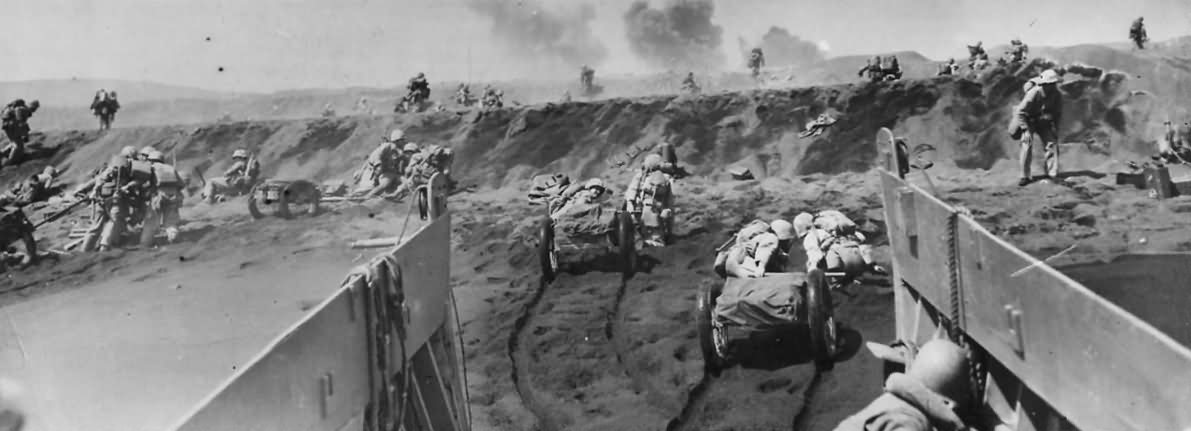
The booted feet of a dead Japanese soldier, foreground, and his hand protrude from beneath a mound of earth on Iwo Jima during the American invasion of the Japanese Volcano Island stronghold in 1945 in World War II. U.S. Marines can be seen nearby in foxholes. (AP Photo/Joe Rosenthal)

Perhaps this is similar to what Mr. Johnson saw during the Battle of Santa Cruz Islands and Guadalcanal where he was gravely wounded.  National Archives.

Perhaps this is similar to what Mr. Johnson saw during the Battle of Santa Cruz Islands and Guadalcanal where he was gravely wounded. Note the position of this dead sailor’s feet relative to his upper body. National Archives.

Okinawa

A US Army soldier lays as he died on Okinawa while the fighting continues around him. National Archives.

Dead Japanese soldier on Luzon, 1945. US Army photo archives.

Dismembered Japanese soldier on Luzon, 1945. US Army photo archives.

British military removing burned German corpse from knocked out tank. National Archives.

British military removing burned German corpse from knocked out Panzer IV tank. National Archives.

Dead Japanese soldier in advanced decomposition.  Perhaps this is what Old Man Jack tried to suppress in his recollection of "ID patrol".

Dead Japanese soldier in decomposition. Perhaps this is an example of what Old Man Jack tried to suppress in his recollection of his morbid experience in “ID patrol“.  US Marine Corps archives.

Two from the US Army 3rd Armored killed in action in France. National Archives.

Two from the US Army 3rd Armored killed in action in France. National Archives.

j pilot

Dead Kamikaze pilot. Notice the rubber glove on the US sailor’s right hand.  US Navy.

flame

Dated March 3, 1944

Perhaps some of the other “it” they saw involved civilians.

russ fem

Records related to this photograph of a slain young Russian female indicate the photo was taken from a dead German’s wallet.

PolandDeadSister

A description that was attached to this photo state a young girl is led away from her sister who was just killed.  Notice the camera in the old man’s hand.  He also sports some kind of arm band.

_____________________________

So why these gruesome photos of carnage and violent death?

Are they REALLY necessary for you to see?

I believe so… and the preceding photos were relatively tame to be quite honest.  There are much more gruesome ones in private collections.  Old Man Jack had a collection but I only got a glimpse of ONE picture early in our relationship and it was of a severed Japanese head.  He never brought the photos out again.

But it’s important that Americans today understand “it” went to the hundreds of thousands of now silent US military graves… and “it” also remains tightly bottled up in the few surviving combat vets from WWII.

They have a right to keep “it” bottled up.  Vacuum sealed.  To keep their sanity although they relive and suffer horribly through “it” each night.

Field grave for an unknown US Marine.

Field grave for an unknown US Marine.  Some souls will never be identified.

Thousands of graves on a “stinkin’ island”… all killed in action.

Iwo Jima

Iwo Jima.  US Marine Corps.

saipan burial

Saipan burial of a Marine killed in action.

French civilians erected this silent tribute to an American solider who has fallen in the crusade to liberate France. Carentan, France., 06/17/1944

French civilians erected this silent tribute to an unknown American solider who has fallen in the crusade to liberate France. Carentan, France., 06/17/1944

waves1

Some souls will never be found.

margrat

Somewhere in northern Europe.

iwo jima cem

Like this torn photograph of an Iwo Jima battlefield cemetery, memories of young boys who lost their lives so violently are fading away.

___________________________

Memorial Day.

To remember those killed.

But without seeing, understanding or accepting the horrible demise these young fighting men encountered ending their short lives, the true meaning of Memorial Day is lost.

It is not truly about the combat vets alive today or who passed away since war’s end…  but they sure the hell are part of it.  Those alive mightily grip a key to their secrets – preventing your entry into their private internal hell.

__________________________

I will remember this when I visit the graves of Old Man Jack and Mr. Johnson this Memorial Day and will think of their fallen comrades.

And I will thank them and their unnamed buddies when I enjoy my barbequed hamburger this Memorial Day weekend and a cigar.

They died for me.

So I could enjoy my hamburger and cigar.

And I shall

A final, short tribute to those resting in graves today:

Army Myths: Confirmed kills

Reblogged from Carrying the Gun:

Click to visit the original post
  • Click to visit the original post

I've checked and double checked my ERB and ORB. There is no category to record my "confirmed kills."

The term "confirmed kill" gets thrown around a lot, especially in sniper circles. The whole idea of a "confirmed" kill suggests there is some process or that there is a forensics team that descends on a body after a shot was fired to confirm unequivocally who gets credit.

Read more… 205 more words

Hollywood has helped blur reality...